Cleaver
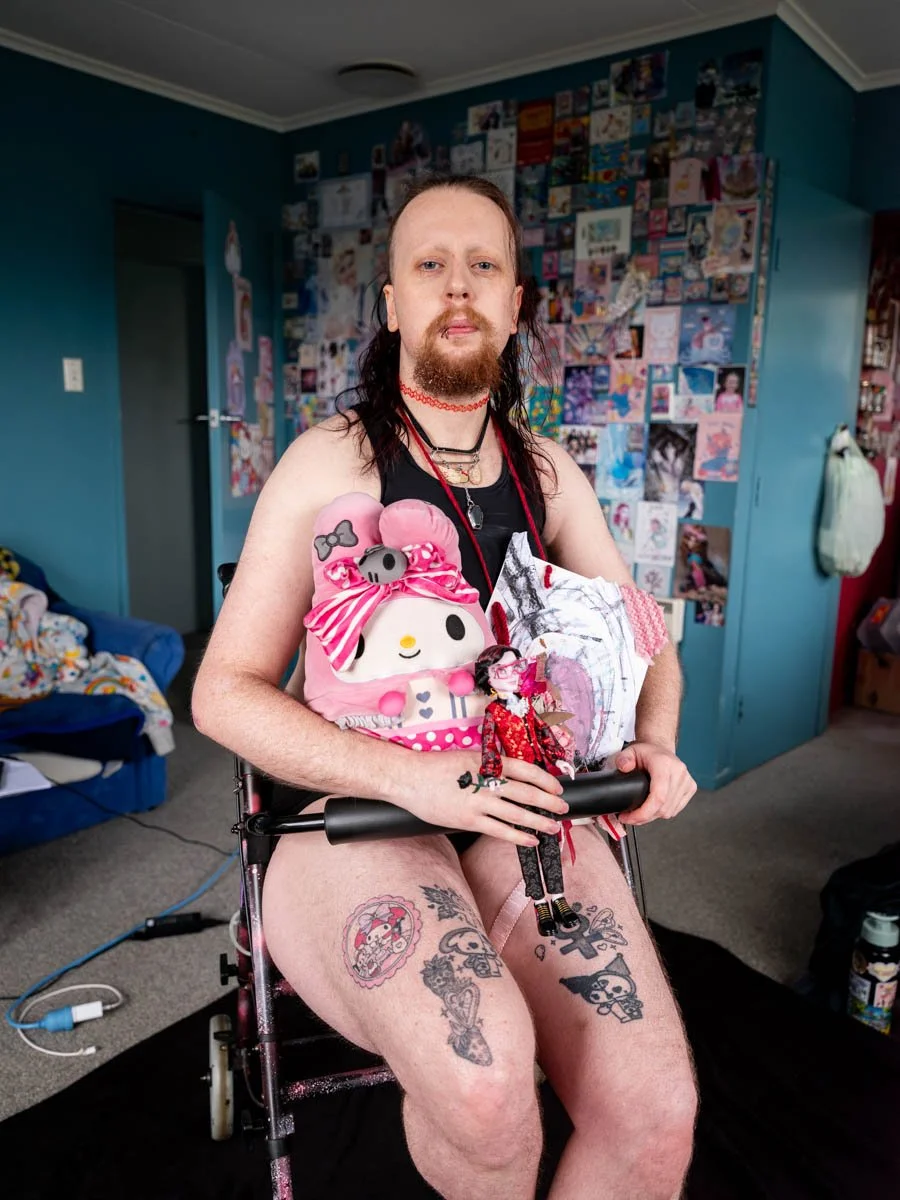
Cleaver, 27, Wellington
Listen to Cleaver’s story here
Read Cleaver’s Story
For endo specifically, as soon as we started ovulating and getting periods, it was not normal. Before I had the hysterectomy and before I had testosterone, I basically had a constant period—that just never stopped. I would be losing so much blood—and in so much physical pain, I would go to the nurse during school hours—quite regularly because I would feel really sick. I would be dizzy. I would get migraines and headaches all the time. And the physical pain and, like, my back. It would make my bowels would be horrible as well—because it's all into that area. Like the pain just radiates from there.
The nurse didn't believe me—because I, I didn't have a temperature. There wasn't anything physical that she could immediately go, "Okay, you are sick."
The first time that I started realizing that something might be wrong—I had just graduated cooking school. And I was working in a kitchen. Most of the kitchen was cis dudes. So I was having to try and pretend to be as normal as possible. And I was also still experiencing those symptoms—while working. I would come home from a 12-hour shift to my queer flat and just have a meltdown. I, I would be crying. I would be very, very ill. And then I wouldn't be able to sleep because all I would be thinking about was how I was going to work.
And a couple of them were disabled. And I, at this point, didn't know that I was disabled. And at one point, one of the more disabled flatmates was like, "Your body is not normal. This is not normal." And someone in the flat also had a friend who had endo, and they were like, "I think some of your symptoms line up with this."
And I had no pain management—to help other than that I had recently started testosterone. I hadn't been on it long enough—for it to be doing very much.
Now that I've been on it for nearly seven years, and I've had a hysterectomy—I had hoped that it would fix things, and in some ways it has. I don't have the bleeding. I don't have as much of the bowel issues. Unless I'm getting really bad, endo bloating. But I'm not having it constantly—which is a very big difference.
And then I am prescribed medical cannabis. And that was very difficult to financially figure out, basically. I had to prove how disabled I was to WINS. I had to basically give up most of my hobbies—within that timeframe—until they'd approved it. Because they completely removed disability allowance—but medical cannabis has meant that I have been able to start doing more of the things that I actually enjoy doing. And just, a quality of life difference.
I think the "it's a woman's only illness" thing really sucks from my perspective specifically. Especially when—through all of the endometriosis treatments that I have received, I have been on testosterone. I would just get misgendered a lot, and screamed at in ED by one of the nurses because I had my gender as male on file. And when I was describing the symptoms that I was experiencing, he could not compute the male on the card and me saying that I have endometriosis in my body. And I've received a lot of barriers to care—because there is no understanding that that can be a thing.
I think that also adds to the level of, like, not being believed. Because it's like, you're already crazy. And people seem very surprised that medical professionals wouldn't understand that, but there is not enough training around endometriosis—in general. Let alone trans people with it.
And the misogyny that you get for having endo from doctors, you still get it. It's just a weird flavor—when you're trans as well.
There are so many scenarios that I have been in, that I'm forced to be in because of endo, and I don't have a choice. And have to somehow, while in so much pain—be able to teach these people what is going on. And most of the time they don't want to listen to you—because they're supposed to be the smart ones in the scenario. And it's like they care more about their ego than they care about the patient—and that means that most of the time if I go to ED, it is not a safe place for me to be. And I am not going to get given any—level of care.
And it's a lot worse now with all the staffing problems—and now, a lot of people can't even afford to go to the doctors—and the GPs also don't do anything. And it's like, what is left?
And I still can't even class it as a disability on my WINZ stuff—because it's not a disability.
I would definitely look for local or online groups. I've found a lot of Facebook groups that have been really, really helpful. And like Endo Warriors has been awesome. Having that information and that support network—is really important. Also, I feel like it's very important to have at least a few trusted people that you know that you can talk about what you're experiencing without judgment.