
Ellen
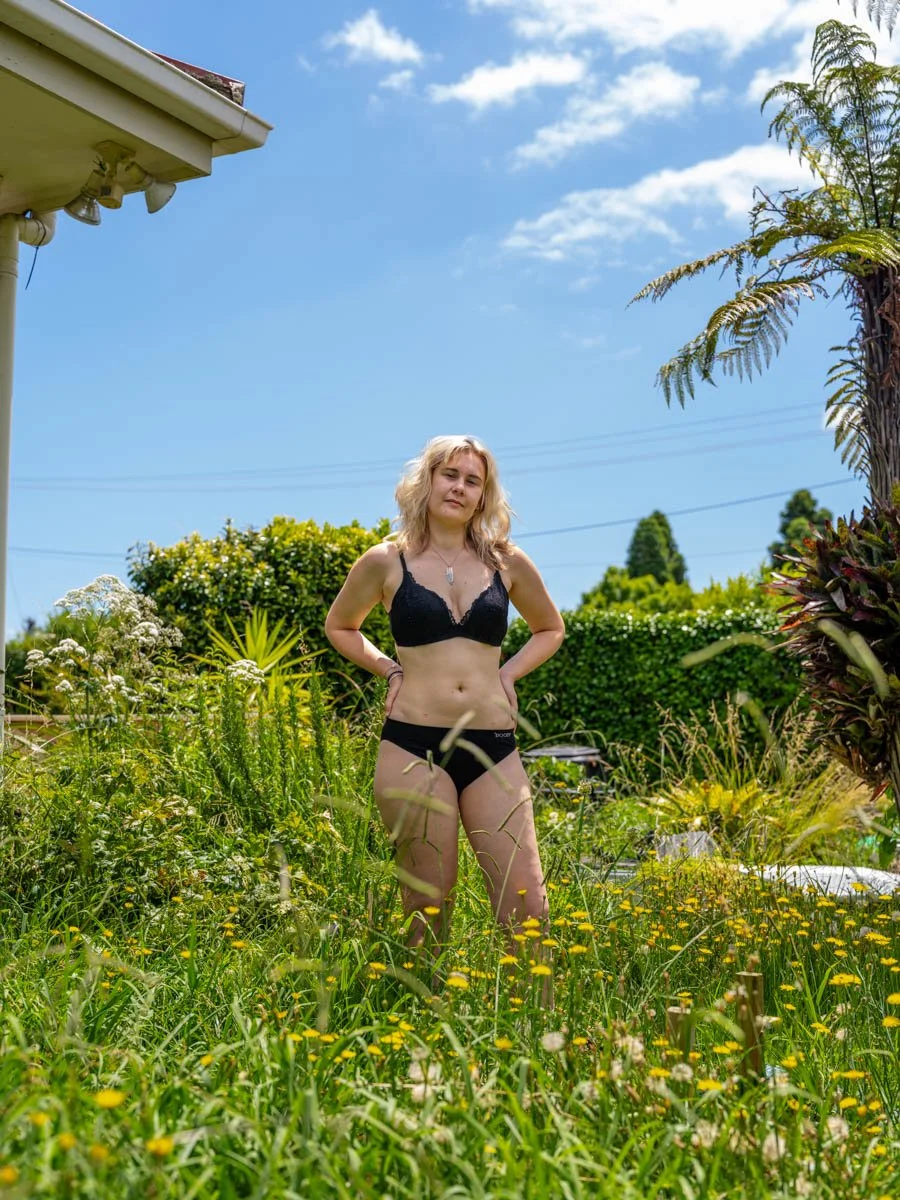
Ellen Larson, 33, Auckland
Listen to Ellen’s Story
Read Ellen’s Story
I had my first period at 12. They were very— But I was not in a position to say, stay at home from school, so I would have to go to school and wag in the toilets or, you know... Hide, survive, just bleeding through everything. And my stepmother would say, "Oh, it's a sign from God that you need heavier menstruation products." It drove me nuts.
And I took myself to the doctors several times, but I had a little old lady GP who said, "We'll put you on the pill." And then it kind of fixed things a little, and then years later when I went back to her 'cause I was getting migraines, everything was getting worse—'cause all the pill really does is mask those symptoms.
They thought I was having miscarriages. But it was really heavy clotting. Like, really, really, really, really bad.
So do you have adeno as well then? Yes. So, um— Okay, that makes sense.
I took myself to the gynecologist. I'm like, "I think I have this." Rolled out a list. I'd written down all the symptoms. And he looked at me and went, "Right. So are you free for surgery next week?"
It was my first surgery ever, and I was told it would be like having your appendix out, and then I came out of it and I never quite recovered—from that surgery. And I would explain it to people and say, "It's literally having every organ and every part of your abdomen cut, scraped," just, you know—bruised, moved around.
You know, a lot of my family went, "Oh, well, you're making it up now, you're being dramatic because you've been in and out of hospital since this operation. This operation should have cured you."
I was on that cusp of stage three, stage four. They nearly pulled out an ovary immediately. It was quite munted. Riddled, absolutely riddled with endo. I had this massive chocolate cyst. I had deep infiltrating endometriosis right down pouch of Douglas all the way... It was getting close to my diaphragm. Full of adhesions as well. I had polyps all through my uterus.
After that, they went on and put me on Zoladex. I was allowed it for, I think they stretched it to two years. Then I was on hormone replacement therapy. My side effects becoming a little bit much. And my gynecologist went, "Right, we'll go in again. Let's have—go through and have another look."
And again, everything was already at stage two. And it was everywhere again, not as bad, but still deep infiltrating.
And around about then they went, "Well, we're gonna check your egg counts." I was told after that, that I'd be infertile by the time I was 30. My egg count was already so low.
I had never wanted children of my own anyway, but I went through a whole grief process. And it was more around— And this is the bit people kind of struggle to understand. It wasn't the fact I couldn't have children, it was more about having the choice taken away. That loss of womanhood. Betrayal of your body to you. That's where it all kind of sat for me.
So I kind of fumbled on for years, in and out of day surgeries with follicular cysts, one was the size of an orange, just so painful. Every year I would go in for Botox in my pelvic floor, nerve block injections, ethosanguinol, et cetera.
So years of this kind of Band-Aid stuff, and I finally managed to talk my gynecologist, I finally talked them into a hysterectomy. It was a complete hysterectomy. So, uh, cervix, uterus, fallopian tubes, one ovary. There was a question on the other one. I left it up to him. I said, "If she looks like she's gonna misbehave, just take her out. I'd rather go into menopause and have that quality of life back than just limping along."
Yeah, it's been a real—journey. Obviously still going. Just because my uterus and that is out doesn't mean no more endo. I still very much get pelvic pain. But it is just very different.
On days where the inflammation is up, your body's spending so much time and energy on inflammation and trying to manage that, so that you get that fatigue, you get that pain, and some days I wake up and I'm like, "I know I'm not gonna get a hell of a lot done today."
Something I wish people understood is that just as no two people experience the world in the same way, no two people experience endometriosis the same way. It's the people with, say, stage 1 endometriosis that are crippled. Absolutely floored, cannot—cannot function as a human being. And then you have people with stage 4 who manage to function until they can't.
I'm a big believer that how they've started to treat it more like cancer. 'Cause it grows as aggressively. It metastasizes. Until they get that classification, bearing in mind that it isn't like having your appendix taken out. If you treat it more like cancer, you get a better picture of what it's like.
I still have days where I sit there and I'm going, "Am I being dramatic? Am I making this up?" And the self-doubt, and questioning, and the harm that kinda does to an individual who actually probably needs some kind of help, or needs to just go, "I need to take it easy today," and that's okay.
Finding a support network—whether that is somebody else with endometriosis you can chat to. Endometriosis New Zealand have a great hotline. Reading as much as you can of recent, credible information. Just getting out there, making sure there's people out there you can talk to. And if you can afford it, talking to someone in the mental health space who specializes in both but, um, yeah, having the mental health support through that makes that so important, not going through that alone.
No matter your situation in life, it's that whole stigma around women's health. No one knows a woman's body better than the woman living in it. And yeah, giving yourself a goddamn break.